Casa x casa
From the collection, "Ernestina & Other Stories"

To our right, if you looked at our house from the front, was an alley, and across from it a house with a small wooden structure on top. Growing up, I always imagined one of the men who lived there—there were three of them—was the murderer, perhaps the oldest, while the other two assisted and cleaned-up after him in preparation for the next kill. It was the woman’s presence that I couldn’t figure out. Her long, greying bronze melena swayed in the wind in perfect harmony with the breeze’s direction; and her smile, which I am choosing to believe was there always, couldn’t have been the trait of a murderer’s daughter. Who is she?
During a hurricane, maybe Hugo or Irene, the wooden second floor flew almost entirely and landed in the alleyway between our two homes. As we helped the neighbor cut down the tree and clear up the alley (it took days!) I realized they couldn’t be murderers, or at least not the way I imagined them to be, though by then I was no longer a kid and could better understand my surroundings. That’s all I remember from the first house. It is worth noting that the members of this family were the whitest people I knew, perhaps because they were more forest people than beach people, strangely, since we lived so close to the ocean.
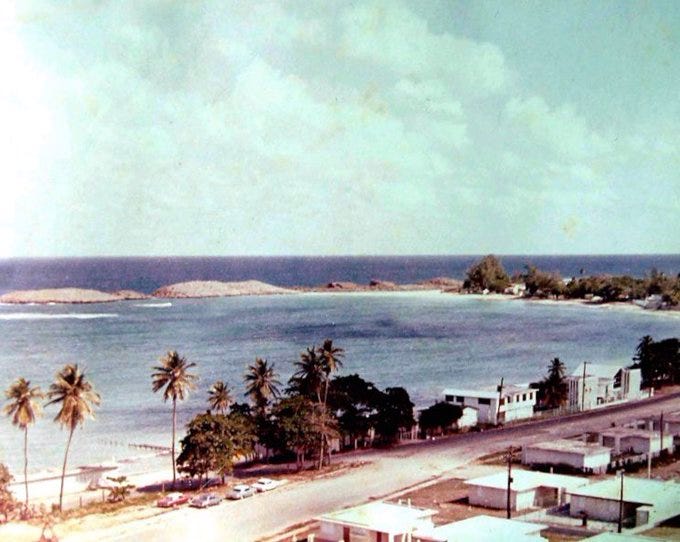
After the alley, came our house and next to us was Vilma’s, who had come from Ponce and whose kids dated people in my family, so they will be skipped lest the telling fuels forgotten family drama. I could say that Vilma’s house had a nice balcony where the view (we lived atop a small slope that overlooked what used to be a lagoon but is now a pastizal) could be appreciated. Nirvana loved jumping over the concrete fence dividing the two front yards, especially on Saturdays, when my neighbor taught me how to wash the wheels, mudguards, and the hoops of a car and then wash and shine the whole thing; things that would have come in handy had I ever owned a car.
The next house was (or still is?) Mari’s, and could I tell you a wild thing about Mari? Yes, I could. I could speak volumes, for Mari was a public-school teacher, well respected by her community, who abused her two kids through their childhood and teen years, getting into throwing and screaming matches that would keep us all up at night. Calls were made, the next-door neighbors who had arrived from Spain had moved away due to the noise (releasing the house for our Ponce neighbors), yet nothing ever changed. After a night of endless shrieking, shouting, breaking, the teacher with both of her teens would walk out the next morning ready for school, like boxers ready for an interview after a match or like a fly that has been tossed aside by a cat’s paw: it limps, it wants to give it all up and yet, at the needed time, it can still fly.
Then came an empty house. Was it always empty?
To its left, lived a family, all women. The three daughters were so beautiful and kind and the plants so welcoming that I cherished every moment inside their home, which were few. The sisters with the large brown eyes and ever-pleasant smiles, that is all I remember of them.
Several houses followed (or was it only one?) arriving at the Pizarros’, a place that to me was almost magical for there lived a whole family that helped raise us, and my mom simply loved them. Black and evangelical, Mr. Pizarro worked as a school teacher of arts and crafts, as well as being a Vietnam vet and reservist. He would arrive sometimes from a deployment, though perhaps it was only training, and bring us military foods in those glossy packets. The Pizarros had four kids closer to my siblings’ age, making me the youngest of a pack of seven. Their house was to me a large living room decorated from top to bottom, frames, and browns, and pinks and couches that overtook every corner. There is little I miss from this small town, but if I missed anything it would be the Pizarros. Except for one of the siblings, a strange teenager who liked playing too closely with the kids. In his twenties, his car crashed and his face became disfigured. My mom told me recently everyone at the Pizarros’ has either passed or moved away. Only this lonely, disfigured man and his mom remain.
The house closest to the lagoon-turned-pastizal belonged to a family of mostly women that we played volleyball with.
On that street in front of the lagoon, I have come to learn that the killers hired by actor Lydia Echevarría to do her husband away hid in one of those houses for several years. The front gate was always locked and allegedly, they lived without power.
Several houses from it stood a house with a large concrete fence and a thrust portico that gave the impression of a small convent or library. Entering it, which I did probably twice, gave the impression of entering a gallery, perhaps due to them being the only family with actual money on the block.
Next to them, back up the other side of the slope, were the surfers, and next to them, a man who on every New Year’s celebration would pull out his gun and shoot bullets up to the sky, an experiment of a person.
Across the street from us, lived a thin, lonesome elderly woman with a younger, mentally disabled relative that she kept hidden most of the time. This was our daily front view; their house sat a couple of feet higher than ours, its grass always green and well-trimmed.
Behind us lived the Dominicans, who some years before I was born, the dirty seventies, moved to these lots—invasiones—and established themselves there. As it turned out, nobody on our block let their kids play with theirs, except for my mom. As we lived next to their neighborhood, the alley between our house and the serial killer’s was the entry way to the Dominican community and there, we ran and played and got lost often. Many of them came home, played baseball with wooden planks still with a scarring nail or two, and dug holes in the yard. As the years went by it was clear we were on different tracks, as some of the family households, like the ones right behind us, sold drugs and made generally a different living than the aspirational-through-hard-work-and-education-boomer-working-class-worldview that enveloped my family. Over time, what many on the block saw as inevitable, did take place. Most of them dropped out of school, joined gangs, walked around with their faces masked by their t-shirts, carrying sticks, no longer for baseball, creeping and breaking into places. As my siblings and I left for college, and our mom was left by herself, tending to three dogs, the guys broke into every house on the block, even the ones not mentioned on this writ. All but one house, ours, and the reason was definitely not the three dogs, namely Nirvana, Karma and Enigma, who were all related.